Relativity Trail   purchasing information                  First edition owners, click here                 Contact                 Synopsis               Cite this book
                                                                                          Second edition owners, click here                 Infamous Twin Paradox               Twins Paradox Animation

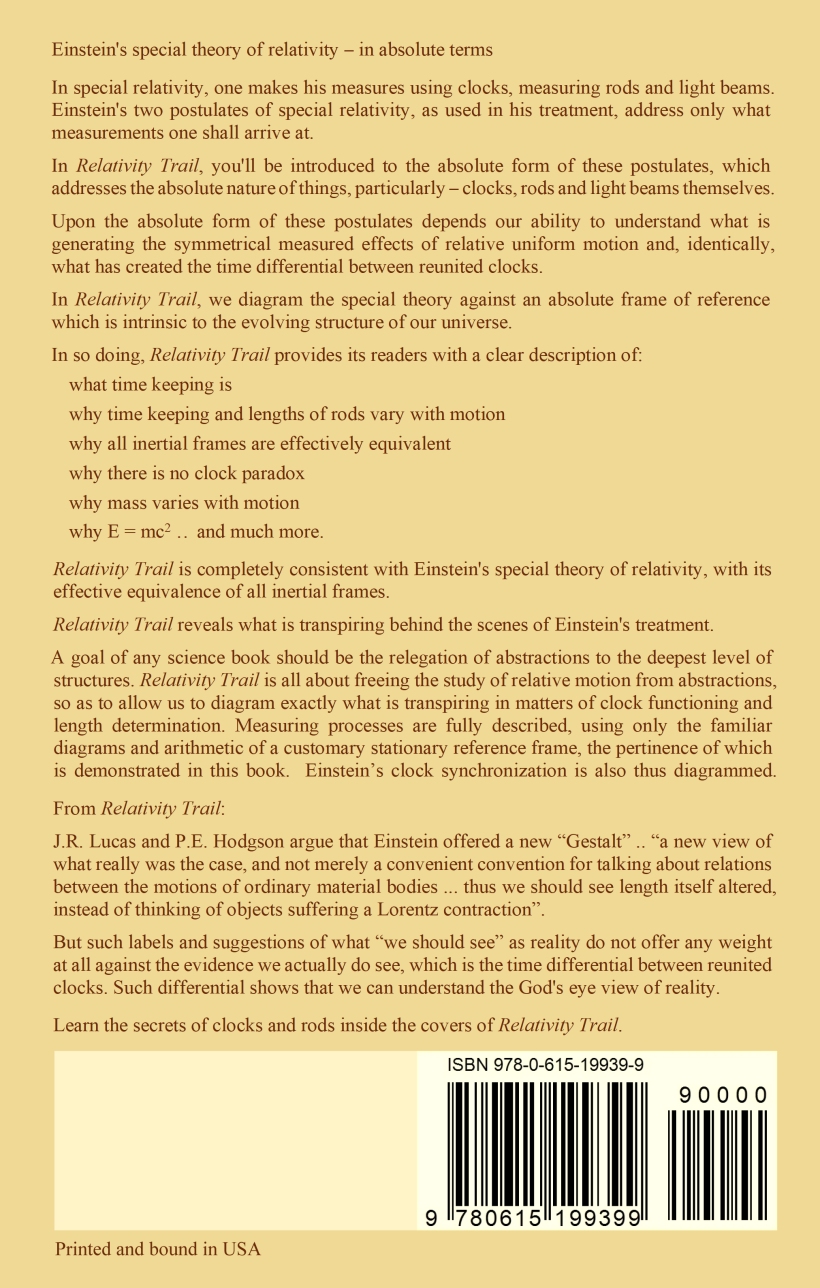
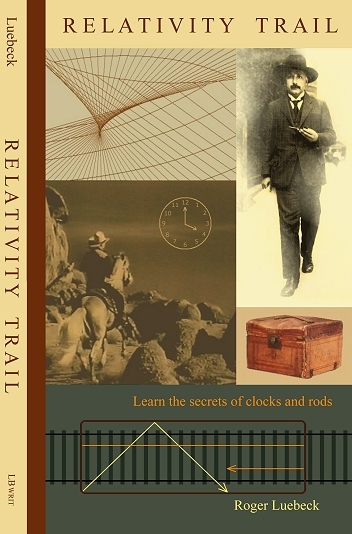
    The back cover:

    Einstein's special theory of relativity, in absolute terms -

    In special relativity, one makes his measures using clocks,              
    measuring rods and light beams.  Einstein's two postulates of 
    special relativity, as used in his treatment, address only what 
    measurements one shall arrive at.

    In Relativity Trail, you'll be introduced to the absolute form 
    of these postulates, which addresses the absolute nature of 
    things, particularly - clocks, rods and light beams themselves.

    Upon the absolute form of these postulates depends our ability 
    to understand what is generating the mutual effects of relative 
    uniform motion and, identically, what has created the time 
    differential between reunited clocks.  

    In Relativity Trail, we faithfully diagram Einstein's special 
    theory against an absolute frame of reference which is intrinsic
    to the evolving structure of our universe.

    In so doing, Relativity Trail provides its readers with a 
    clear description of: 
       
  • what time keeping is
  • why time keeping and lengths of rods vary with motion
  • why all inertial frames are effectively equivalent
  • why there is no clock paradox
  • why mass varies with motion
  • why E = mc2
and much more. Relativity Trail provides a straightforward derivation of the Lorentz transformations.
    A goal of any science book should be the relegation of abstractions 
    to the deepest level of structures.  Relativity Trail is all about 
    freeing the study of relative motion from abstractions, so as to 
    allow us to diagram exactly what is transpiring in matters of clock 
    functioning and length determination.  Measuring processes are
    fully described, using only the familiar diagrams and arithmetic of 
    a customary stationary reference frame, the pertinence of which is 
    clearly demonstrated in this book.

    Relativity Trail is completely consistent with Einstein's special 
    theory of relativity, with its effective equivalence of all 
    inertial frames.  It is not the relativity of the aether or of 
    variable light speed.     

    From Relativity Trail:

    "J.R. Lucan and P.E. Hodgson argue that Einstein offered a new
    "Gestalt", "a new view of what really was the case, and not
    merely a convenient convention for talking about relations
    between the motions of ordinary material bodies" ... "thus we
    should see length itself altered, instead of thinking of objects
    suffering a Lorentz contraction".

    But such labels and suggestions of what "we should see" as
    reality do not offer any weight at all against the evidence we
    actually do see, which is the time differential between reunited
    clocks.  Such differential shows that we can understand the
    God's eye view of reality."  

    Learn the secrets of clocks and rods inside the covers of 
    Relativity Trail.


   Relativity Trail has 192 pages (including blank & misc)
   with 60 colored diagrams and 76 colored illustrations,
   softcover, perfect bound, gloss laminate finish.


   You may view a sampling in this 41 page pdf file.  Images are included.

   Click here
   for the pdf file.                                   then select
                                                       fit to page.
   select facing pages,


   Click here for the snapshots of all 192 pages of Relativity Trail.


   09/25/2011 update, reflecting news from CERN:

   The absolute interpretation of relativity, as presented in
   Relativity Trail, is unaffected, and in fact would be substantiated, 
   by the recent results from the OPERA detector in Gran Sasso, Italy, 
   which detected neutrinos generated at CERN arriving sooner than 
   expected, indicating they were moving faster than light.

   First note that Relativity Trail is completely consistent 
   with Einstein's relativity, with its effectively equivalent inertial 
   frames, including the consistent measured speed of light in all 
   inertial frames.

   In Relativity Trail, the effects of relativity are deduced
   by considering that clock functioning, as well as the speed of 
   our perceptions, are dictated by the finite speed of light.  
   The only relevant issue is that all phenomena is constrained by 
   some finite speed, which is what light speed is regarded as, 
   whether it is the maximum speed or not.

   In Einstein's relativity, it is deduced that the speed of light 
   is the maximum speed, based on assumptions about time.  With that 
   arbritrary starting point, he made relativity more sacred than 
   it should have been, with the subsequent shrieking we now hear.

   Well, perhaps it has now been experimentally confirmed that the
   effects of relativity are, as claimed in Relativity Trail, 
   a very close approximation of reality.  It is likely, as 
   mentioned on page 20 of Relativity Trail, that a photon
   may have nil, rather than zero mass.  If a neutrino's speed is 
   greater than that of a photon, a precise enough measure would 
   reveal that, leaving us to conclude that a photon actually has 
   a very tiny mass, as does a neutrino.  In fact, it's well known
   that unless we consider photons as having some rest mass, certain 
   definitions and equations of physics break down.  The development
   and understanding of relativity in Relativity Trail are
   unnaffected by such considerations.

   As explained in Relativity Trail, the effects of relativity are, 
   in either case, actually an approximate effect, dependent on 
   the complexity of the universe, since the sum total of the universe
   itself serves as the ultimate and true frame of reference for motion 
   and acceleration.  That frame of reference changes some tiny amount 
   with every action of any particle in the universe.  It's really
   not fundamentally different from the Uncertainty Principle.

   An object's inertial properties (e.g. mass) are integral to its 
   relationship with totality.  Because the effects of relativity 
   are ever more precise with an increasingly complex universe, 
   relativity is virtually true in our very complex universe.


   -----------------------------------------------------------------

   From page 35:   

   "This has everything to do with the notion of complexity giving 
   rise to the meaningfulness of physical properties, which is implicit 
   in all our arguments pertaining to an object's relationship to 
   totality. A very simple universe would impart inertial properties 
   in a much rougher manner than does the universe in which we live, 
   and those properties would mean much less."

   From page 121 (3rd edition, c 2010):

   "Now from the God's eye view we can assess the dynamics of a, say, 
   three component universe.  As noted on pages 35 and 140-141, such 
   a simple universe will produce cruder results: There will be 
   substantial time contraction for all three components, assuming 
   their "masses" are comparable to one another.  But there really 
   isn't much to talk about here. It's irrelevant to the extent that 
   it is not nearly complex enough to produce the virtual absolute 
   effects as we know them."

   From page 141 (different page number for 1st and 2nd edition)
   regarding the effect on the rest of the universe when an object
   moves:  

   "Technically, this is true even for the universe as it actually is. 
   It's just that it is far too small an effect to be detected or to 
   be of any practical consequence."